

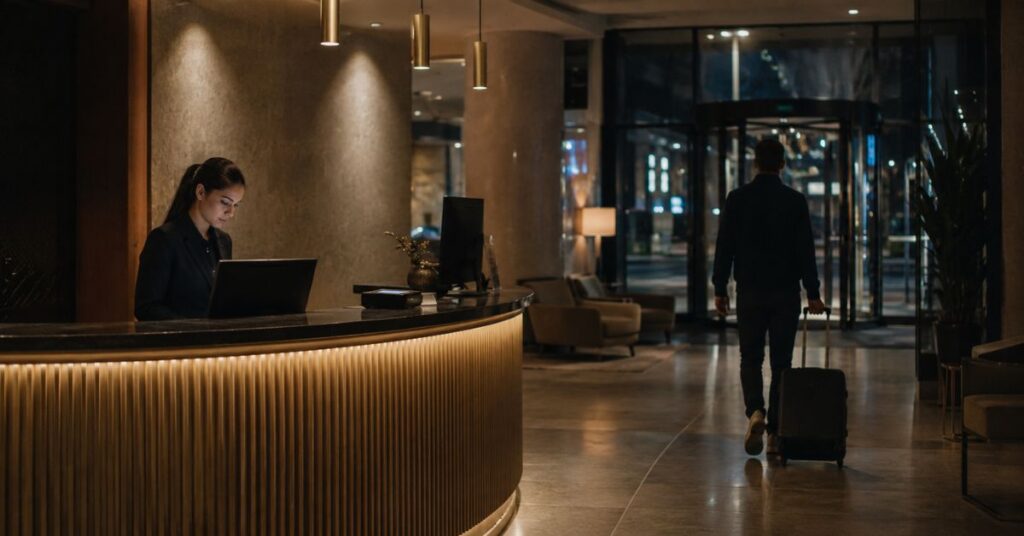
Why Are Hotels Modernising Reception with Self Check-In?
For decades, the hotel front desk has been at the heart of the guest arrival experience. But staffing shortages, rising labor costs, late-night arrivals and changing guest expectations are making the traditional model harder to operate efficiently.
Guests increasingly expect flexible, fast and convenient arrivals without unnecessary queues. This is where hotel self-check-in and hotel check-in software can help.
Rather than replacing hospitality, automated hotel check-in reduces repetitive front-desk tasks, allowing hotel staff to focus on guests who need personal assistance.
The Problem: The Hotel Front Desk Is Not Always Needed 24/7
One of the biggest challenges for hotels is that guest arrivals do not follow a fixed schedule.
- A guest may arrive at 15:00.
- Another may arrive at 20:30.
- A delayed flight might mean another guest arrives at 00:45.
- And someone driving from another city could arrive at 02:00.
The traditional solution is to keep reception staffed for as many hours as possible. But this creates an obvious operational problem.
Keeping reception staffed around the clock can increase labor costs, especially for smaller hotels. This is where hotel automation can help. Instead of eliminating the front desk, hotels can automate repetitive check-in tasks and let staff focus on guests who genuinely need personal assistance.
Staff Shortages Are Making the Traditional Model More Difficult
Staffing has become one of the major operational challenges for hospitality businesses. Research on Austria’s tourism sector has highlighted the impact of labor shortages, including the risk that insufficient staffing can reduce operating capacity.
The issue is not simply finding enough people. Hotels also need to deal with:
- Recruitment costs
- Employee turnover
- Shift planning
- Night shifts
- Sick leave and holiday cover
- Training
- Rising wages
- Administrative workload
Germany is facing similar pressure. Industry outlooks for the German hotel market identify digitalisation and automation as increasingly important tools for dealing with rising costs, staffing shortages and changing guest expectations.
This changes the conversation around hotel technology. Automation is no longer only about creating a more modern guest experience. For many hotels, it is becoming an operational strategy.
The Hidden Cost of a Manual Check-In
Check-in looks simple from the guest’s perspective. But behind a traditional arrival, there can be several manual steps:
- Welcoming the guest
- Confirming the reservation
- Checking identification
- Collecting or confirming guest information
- Handling payment
- Explaining hotel information
- Preparing or issuing the room key
- Answering questions
- Handling special requests
- Dealing with late arrivals
When there are several guests arriving at once, these tasks quickly create queues.
When there is only one late-night arrival, the problem is different: the hotel may still need to dedicate staff resources to the process. This is where hotel self-check-in can make a measurable operational difference.
Instead of requiring an employee to manually complete every routine step, the system can guide guests through the arrival process themselves.
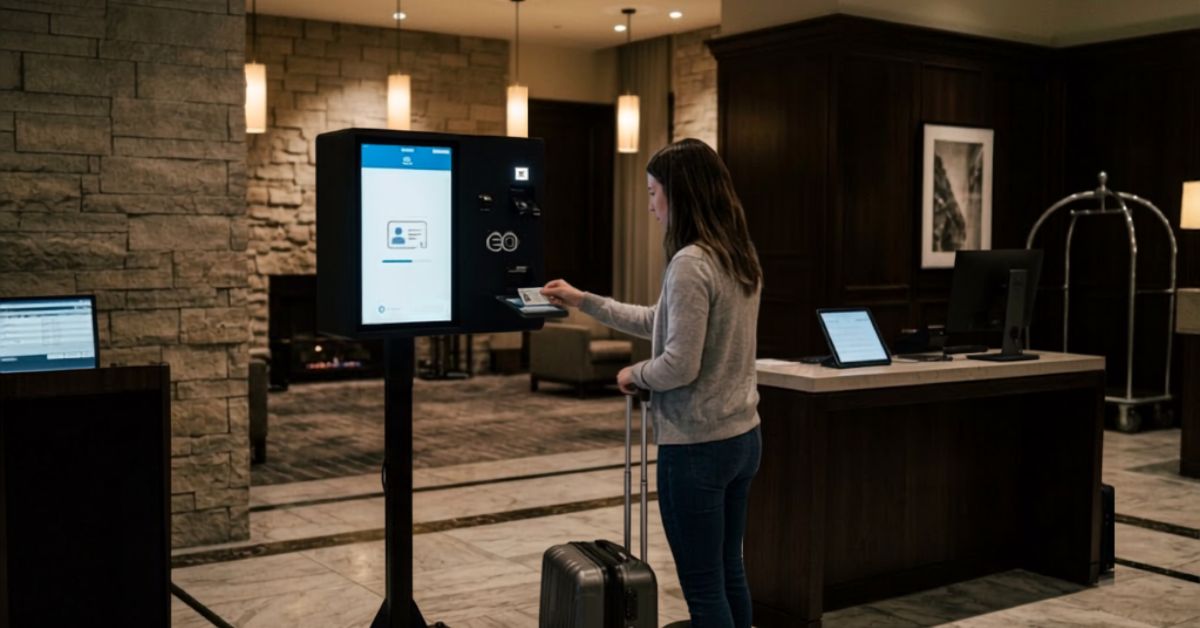
Self-Check-In Kiosks: Turning the Lobby Into a Self-Service Arrival Point
A self-check-in kiosk can act as an additional arrival channel for hotel guests. Instead of joining a reception queue, a guest can approach the kiosk and follow the check-in process on screen.
For hotels, this creates several potential advantages.
1. Faster Arrivals
Guests can complete routine steps without waiting for an employee to become available.
2. Reduced Reception Workload
Staff no longer need to manually handle every straightforward arrival.
3. Better Support for Late Arrivals
Guests arriving outside normal reception hours can potentially complete their arrival independently.
4. More Flexible Staffing
Hotels can reduce the need to schedule employees around unpredictable arrival times.
5. A More Consistent Process
The same digital workflow can guide every guest through the required steps.
The result is not necessarily a reception-free hotel. It is a hotel where reception staff can focus less on repetitive administration and more on hospitality.
Automated Hotel Check-In and the Changing Guest Experience
Guest expectations are changing. Travelers are increasingly familiar with self-service experiences in airports, retail, banking, and transportation. Hospitality is following the same direction. Recent hospitality research and industry reporting point toward growing interest in flexible, self-service guest journeys and technology that removes friction from hotel stays.
For many guests, the ideal arrival is simple:
Arrive → identify yourself → check in → access your room.
They may not necessarily want a five-minute conversation with reception after traveling for several hours. At the same time, other guests absolutely want human interaction. That is why the best approach is not necessarily to choose between technology and hospitality. Hotels can offer both.
- A guest who wants assistance can speak to reception.
- A guest who prefers speed and independence can use automated hotel check-in.
This creates a more flexible arrival experience.
Contactless Hotel Check-In Is About Convenience, Not Just Contact
The term contactless hotel check-in became widely associated with the pandemic, but the underlying idea has evolved. Today, contactless check-in is increasingly about convenience.
Guests may want to:
- Avoid waiting in line
- Arrive late
- Complete registration independently
- Reduce unnecessary interaction
- Move quickly from the entrance to their room
For hotels, contactless processes can also reduce the number of repetitive interactions reception staff need to manage. The goal should not be to make hospitality impersonal.
The goal is to make routine processes easier.
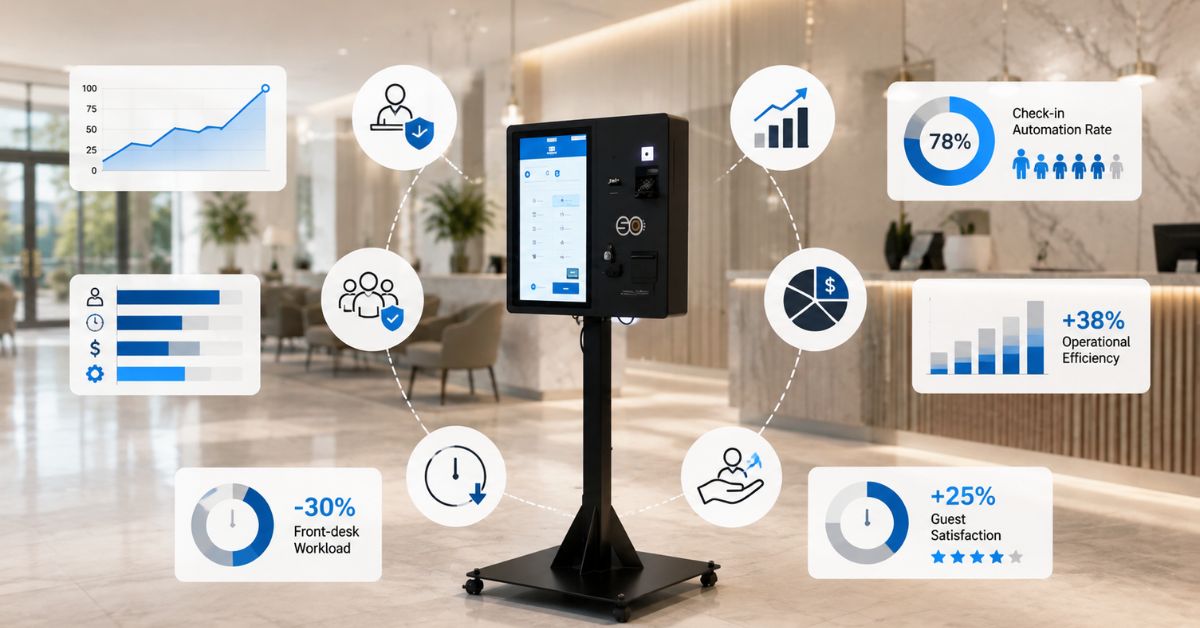
The ROI of Hotel Self-Check-In
The business case for self-check-in should go beyond simply saying that it is “modern.” Hotels need to understand the return on investment. The calculation will vary depending on property size, staffing model, occupancy, arrival patterns, and technology costs.
However, hotels can evaluate several measurable areas.
Reduced Front-desk Workload
If employees spend less time processing routine arrivals, those hours can be redirected toward higher-value activities.
For example, instead of processing a straightforward check-in, a receptionist could:
- Help a guest with a special request
- Handle a booking issue
- Respond to an operational problem
- Assist another department
- Spend more time with guests who actually want personal service
Lower Dependence on Night Reception
For properties that receive relatively few arrivals overnight, self-service technology can provide an alternative to staffing the desk solely for occasional late arrivals.
Faster Guest Processing
Shorter queues can improve the arrival experience, particularly during busy periods.
Better Scalability
A digital check-in process can handle multiple guests simultaneously, whereas one receptionist can only process a limited number of arrivals at once.
More Efficient Use of Existing Staff
Perhaps the most important benefit is not necessarily reducing headcount. It is getting more value from the people you already employ.
That distinction matters.
The objective of hotel automation should be to reduce repetitive work, not reduce hospitality.
A Simple Hotel Self-Check-In ROI Example
Consider a hypothetical 50-room hotel. Suppose reception spends an average of five minutes processing a straightforward arrival.
If 30 guests arrive on a busy day, that represents:
30 × 5 minutes = 150 minutes
That is 2.5 hours of staff time spent on basic check-in activity in one day.
The actual financial impact depends on the hotel’s labor cost and how much of that time can realistically be automated. But the calculation demonstrates why even a few minutes per arrival can add up significantly over a month or a year.
Hotels should therefore calculate:
Annual check-in volume × average minutes per check-in × effective staff cost per hour
Then compare the resulting operational cost with the investment in hotel check-in technology. This provides a much more useful ROI calculation than simply comparing software subscription prices.
Self-Check-In Does Not Mean Removing Your Reception Team
This is one of the most important points for hoteliers considering automation. A self-check-in solution should not be viewed as a replacement for hospitality. Instead, it can act as an additional service channel.
Think of it as:
Automation for routine tasks + employees for meaningful interactions.
- A guest with a straightforward reservation can check in independently.
- A guest with a problem can still speak to a staff member.
- A family needing recommendations can receive personal assistance.
- A guest celebrating a special occasion can receive a personal welcome.
In this, the technology handles the predictable processes. Staff handles the human moments. That is often a much better use of hospitality employees’ time.
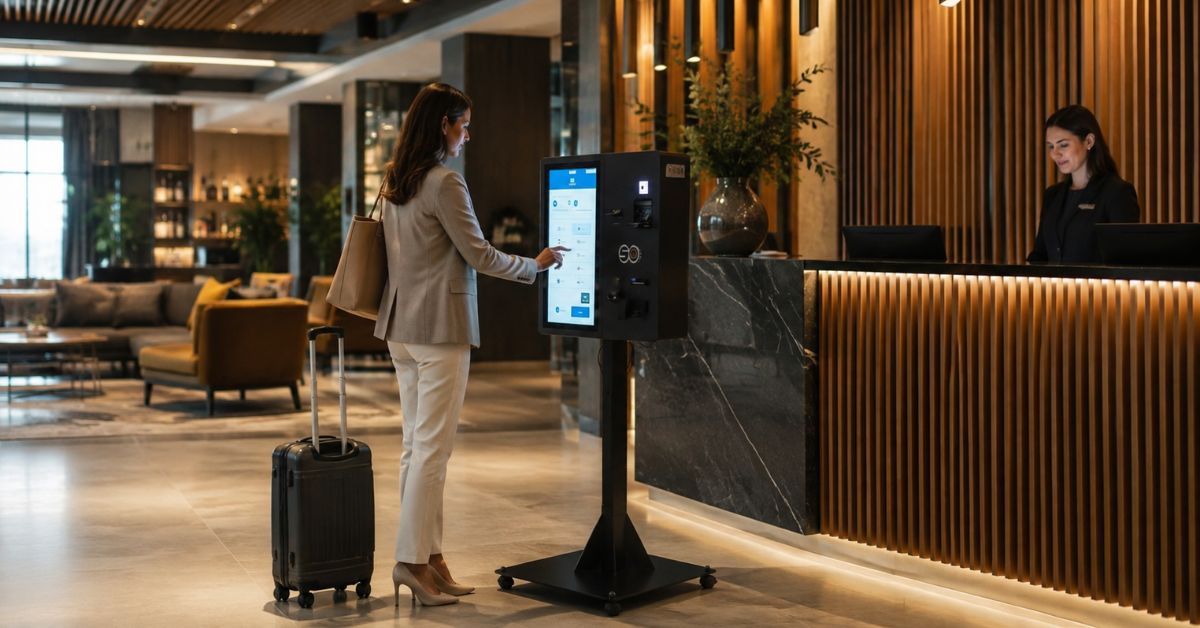
What Should Hotels Look for in Hotel Check-In Software?
Not every hotel check-in system is the same. Before investing, hotel operators should consider how the software fits into their existing technology stack.
- PMS Integration: The check-in solution should work with the hotel’s existing property management system wherever possible. Manual duplication of reservations and guest data can undermine the benefits of automation.
- Guest Identification and Registration: The system should support the hotel’s legal and operational requirements for guest registration and identification.
- Payment Processing: If payment is part of the arrival process, hotels should consider how the solution handles payments securely.
- Key or Access Integration: A smooth journey should ideally connect check-in with room access. The guest should not complete digital check-in only to discover that they still need to wait at reception for a physical key.
- Remote Support: Hotels should have a way to assist guests when something goes wrong. Automation works best when there is a clear fallback to human support.
- Multilingual Experience: For hotels serving international travelers, the check-in journey should be easy to understand regardless of the guest’s language.
- Reporting and Analytics: Hotel managers should be able to understand how often self-check-in is being used, where guests abandon the process and how the system affects operations.
How to Implement Automated Hotel Check-In?
Hotels do not necessarily need to transform their entire operation overnight. A phased approach is often more practical.
Step 1: Analyze Your Arrival Patterns
Look at:
- Average arrival time
- Number of late arrivals
- Peak check-in periods
- Average check-in duration
- Reception staffing by hour
- Number of guests requiring assistance
This establishes the real operational problem.
Step 2: Identify Repetitive Processes
Determine which parts of check-in genuinely require an employee and which can be automated.
Not every step needs to be digital.
Step 3: Choose the Right Self-Service Model
Depending on the property, this might mean:
- Mobile self-check-in
- A self-check-in kiosk
- Digital registration
- Automated payment
- Keyless room access
- A combination of several technologies
Step 4: Integrate with Existing Hotel Software
The goal should be a connected process rather than another isolated system. This is particularly important for hotels evaluating hotel software in Austria, where operators may already have established PMS, booking and payment workflows.
Step 5: Start With a Pilot
Rather than immediately deploying automation across every arrival, hotels can begin with:
- Late-night arrivals
- Specific room categories
- Selected days
- A single property
The hotel can then measure the results.
Step 6: Measure the Impact
Track:
- Average check-in time
- Reception workload
- Number of self-check-ins
- Late-night staff requirements
- Guest satisfaction
- Check-in abandonment
- Support requests
This turns hotel automation from a technology experiment into a measurable business project.
Where HOS Booking Fits Into the Modern Hotel Arrival
For hotels modernizing the guest journey, HOS Booking connects booking and guest arrival with digital hotel technology. The goal isn’t just self-check-in; it’s a connected journey from booking to arrival to room access.
By bringing these processes together, hotels can reduce manual work, improve efficiency, and create a smoother guest experience.
The Future of the Hotel Front Desk Is Not Necessarily “No Front Desk”
Hotel automation doesn’t mean eliminating the reception desk. The future is more likely to be hybrid: technology handles routine processes, while staff focus on complex requests and meaningful guest interactions.
This approach is especially useful for independent hotels facing staffing and cost pressures, helping them maintain service quality while using their teams more efficiently.
Key Takeaways
- Hotel Reception is Changing: Rising labor costs, staff shortages and late-night arrivals are making traditional 24/7 reception harder to manage.
- Guests Want Flexibility: Many travelers prefer fast, convenient and contactless check-in without waiting in line.
- Self-check-in Reduces Repetitive Work: Hotel self-check-in and hotel check-in software can automate routine arrival tasks.
- Automation Doesn’t Replace Hospitality: A hybrid model lets technology handle routine processes while staff focuses on guests who need personal assistance.
- Self-check-in can improve ROI: Reducing manual check-in work can help hotels use staff time more efficiently and lower operational pressure.
- The Right Technology Should Be Connected: Solutions such as HOS Booking can connect booking, check-in, and guest arrival into a smoother digital journey.
- The Future is Hybrid: Hotels can combine technology with human service to improve efficiency without losing the personal touch.
- For Hotels in Austria and Germany: Investing in hotel automation can be a practical way to respond to staffing challenges, rising costs and changing guest expectations.
