

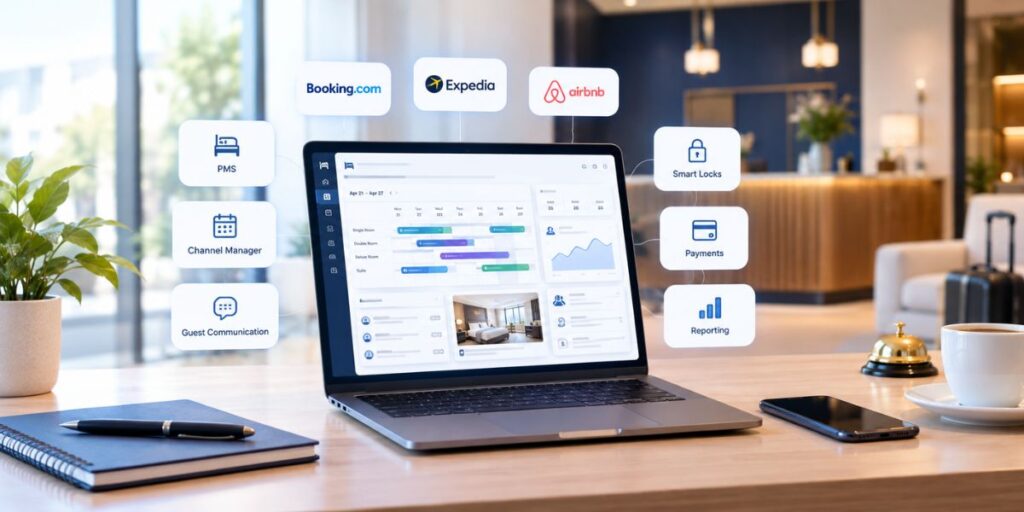
Hotel Software Comparison 2026: 6 Best PMS Systems for Hotels
Choosing a hotel PMS is not simply a software purchase. It affects reservations, distribution, payments, housekeeping, guest communication, reporting and the way your staff work every day.
In this Hotel Software Comparison 2026, we compare six hotel PMS platforms relevant to hotels in Germany, Austria, and the wider DACH market: HOS Booking, Mews, Oracle OPERA Cloud, Apaleo, Planet/Protel, and Cloudbeds.
We compare them by core PMS functionality, automation, integrations, channel management, guest experience, scalability, pricing transparency, and suitability for different hotel types.
Our goal is not to declare one universal winner. It is to help you identify the PMS that best matches your hotel’s size, operating model, technology stack, and growth plans.
Quick Answer: Which Hotel PMS Is Best?
- HOS Booking: Best for independent and small-to-mid-sized hotels seeking an integrated PMS with automation and third-party integrations.
- Mews: Best for highly automated hotel operations.
- Oracle OPERA Cloud: Best for enterprise and complex hotel operations.
- Apaleo: Best for API-first and modular hotel technology.
- Protel / Planet: Best for established hotel operations and broader enterprise requirements.
- Cloudbeds: Best for independent and boutique accommodation businesses.
How We Compared Hotel Software in 2026
To create this hotel software comparison, we evaluated each PMS based on the factors that matter most to modern hotels: core PMS functionality, reservation management, channel management, booking engine capabilities, automation, payments, self-check-in, housekeeping, reporting, integrations, scalability, pricing transparency and suitability for different hotel types.
We also considered the needs of hotels operating in Germany, Austria and the wider DACH market, including data protection, invoicing, local payment requirements and multilingual support.
Information was reviewed using publicly available provider information and product documentation. Features, integrations and pricing can change, so hotels should confirm current functionality and commercial terms directly with each provider.
Last reviewed: September 2026.
Hotel Software Comparison: The Best PMS Systems at a Glance
The following table provides a starting point for comparing popular PMS platforms.
| PMS | Best For | Main Strength | Potential Limitation | Pricing |
|---|---|---|---|---|
| HOS Booking | Independent & small/mid-sized | Integrated PMS & automation | Less focused on large enterprise groups | From €7/mo |
| Mews | Automated hotels | Digital operations | Compare implementation & pricing | Quote |
| OPERA Cloud | Enterprise | Complex hotel operations | May be excessive for small hotels | Quote |
| Apaleo | Tech-focused hotels | API-first architecture | More technology planning | Quote |
| Protel / Planet | Established hotels | Broad ecosystem | Compare implementation & TCO | Quote |
| Cloudbeds | Independent hotels | Cloud PMS & distribution | Check integrations | Quote |
Note: Feature availability can depend on the selected package, integrations, and property configuration. Verify individual requirements with each provider.
What Is the Best Hotel Software in 2026?
The best hotel software depends on your requirements and the hotel’s:
- Number of rooms
- Number of properties
- Business model
- Staff size
- Distribution channels
- Existing technology
- Automation requirements
- Integration requirements
- Budget
- Growth plans
A small independent hotel may prioritize simplicity and affordability, while a large international hotel group may require complex multi-property functionality and enterprise integrations.
Here is a simple way to think about the market:
Best automation for independent and small-to-mid-sized hotels: HOS Booking
HOS Booking is designed for hotels and hospitality businesses that want to manage core operations from a connected cloud platform. Its current product offering combines PMS functionality with reservations, channel management, payments, self-check-in, guest communication, and other operational tools.
Best for highly automated hotel operations: Mews
Mews positions its platform as a hospitality management system covering areas such as PMS, revenue management, payments and POS. Its platform is designed for hotels, groups, hostels, extended-stay properties and independent operators.
Best for complex and enterprise hotel operations: Oracle OPERA Cloud
Oracle OPERA Cloud is designed to support a broad range of hotel operations, including front desk, housekeeping, maintenance and guest services. Oracle also provides integrations with other hotel technology through its hospitality ecosystem.
Best for API-first hotel technology: Apaleo
Apaleo is particularly relevant for hotels and groups that want an open, modular technology environment and extensive integrations.
Best for established hotel operations: Protel / Planet
Protel and the wider Planet ecosystem are relevant for hotels looking for established hotel technology and broad operational integrations.
Best for independent properties seeking an integrated cloud platform: Cloudbeds
Cloudbeds is another option worth evaluating for independent and boutique accommodation businesses looking for cloud PMS, distribution, and booking functionality.
PMS Comparison: The Leading Hotel Software Systems
1. HOS Booking
HOS Booking is a cloud-based hotel management platform designed for hotels in Germany, Austria, and other European markets. The platform combines multiple hotel functions in one system, including:
- Hotel PMS
- Reservation management
- Housekeeping
- Guest profiles
- Invoicing
- Reporting
- Channel management
- Payments
- Self-check-in
- Guest communication
- Kiosk integration
- Door access control
- Multi-property operations
HOS Booking is primarily positioned for independent and small-to-mid-sized hotels, while its platform also supports multi-property operations. HOS Booking currently states that more than 300 hotels, hospitality businesses, and holiday properties use its platform.
Why consider HOS Booking?
One of the biggest reasons hotels consider an all-in-one PMS is to reduce the number of disconnected systems they need to manage.
Instead of having separate systems for reservations, payments, guest communication and digital check-in, hotels can bring these workflows together.
This can help hotel teams:
- Reduce repetitive administrative work
- Centralize operational information
- Automate routine processes
- Improve communication between departments
- Give guests more self-service options
- Access hotel information remotely
HOS Booking also offers specific hotel software pages for Germany and highlights features designed to support GDPR requirements, euro currency support, multilingual interfaces, VAT-ready invoicing, and multi-property management.
Who should consider HOS Booking?
HOS Booking can be particularly relevant for:
- Independent hotels
- Boutique hotels
- Small hotels
- Mid-sized hotels
- Apartments and holiday properties
- Hotels looking to automate operations
- Properties replacing an outdated PMS
- Hotels wanting to combine PMS and digital guest services
HOS Booking pricing
HOS Booking offers flexible hotel software pricing based on your property’s size, room count, and selected functionality. The Basic plan starts at €7/month, while pricing for higher plans is available on request. Because the total cost can vary depending on your property’s requirements, integrations, and selected features, hotels should contact HOS Booking for a personalized quote.
HOS Booking: Best for
Hotels looking for an integrated cloud-based hotel management platform with a strong focus on automation and digital operations.
Potential Considerations
HOS Booking is particularly suited to independent and small-to-mid-sized properties. Larger enterprise hotel groups should evaluate whether its current integrations, reporting requirements, and enterprise functionality match their operational complexity.
2. Mews
Mews is a cloud-based hospitality management platform with a strong focus on automation and digital hotel operations.
Its current platform includes PMS, revenue management, payments and POS capabilities, and it serves hotels, groups, independent properties, hostels and extended-stay businesses. Mews currently states that its platform is used by more than 15,000 properties worldwide.
Key strengths
- Cloud-based operations
- Automation
- Digital guest journey
- Payments
- Integrations
- Multi-property functionality
- Modern user experience
Who should consider Mews?
Mews can be particularly interesting for hotels that want to modernize operations and automate a significant part of the guest journey.
Potential consideration
Mews may be particularly attractive to hotels prioritizing automation and digital operations. Hotels should compare its pricing, implementation requirements, and integrations against their specific technology stack.
3. Oracle OPERA Cloud
Oracle OPERA has been a major name in hotel property management for many years, particularly among larger and more complex hotel businesses.
OPERA Cloud provides functionality for hotel operations including check-in and check-out, housekeeping, maintenance and guest service. Oracle also emphasizes the ability to integrate its cloud PMS with other technologies.
Key strengths
- Enterprise capabilities
- Complex hotel operations
- Large properties
- Multi-property environments
- Broad technology ecosystem
- Integration capabilities
Who should consider OPERA Cloud?
OPERA Cloud is particularly relevant for:
- Large hotels
- Hotel groups
- International operators
- Complex hospitality businesses
- Properties with extensive technology requirements
Potential consideration
Smaller independent hotels should assess whether they actually need the complexity and breadth of an enterprise PMS.
4. Apaleo
Apaleo takes a different approach to hotel technology. Rather than trying to provide every hospitality function inside one closed ecosystem, its architecture emphasizes openness, APIs and integrations.
Key strengths
- API-first approach
- Open architecture
- Integrations
- Modular technology stack
- Multi-property potential
- Flexibility
Who should consider Apaleo?
Apaleo can be attractive to:
- Technology-focused hotel groups
- Serviced apartment operators
- Digital-first hospitality businesses
- Hotels with specialized technology requirements
- Operators building a modular hotel technology stack
Potential consideration
An open and modular architecture can provide significant flexibility, but it may also require more technology planning than a straightforward all-in-one PMS.
5. Protel / Planet
Protel is a well-known hotel software name in the European and DACH hospitality market and is now part of the Planet ecosystem.
Current DACH comparison research frequently includes Protel/Planet alongside Mews, Apaleo, and Oracle when discussing PMS options for hotels in the region.
Key strengths
- Hotel-specific functionality
- Established market presence
- DACH relevance
- Integrations
- Support for complex hotel operations
Who should consider it?
Protel/Planet can be relevant for hotels that need established hotel technology and a broad operational ecosystem.
Potential Consideration
Hotels should compare the platform’s functionality, implementation requirements, integrations and total cost against their property’s size and operational complexity.
6. Cloudbeds
Cloudbeds is a cloud-based hospitality platform that is particularly relevant to independent hotels and smaller hospitality businesses.
Key strengths
- Cloud PMS
- Reservations
- Booking functionality
- Distribution
- Channel management
- Integrations
- Automation
Who should consider Cloudbeds?
Cloudbeds can be worth evaluating for independent and boutique hotels looking for a relatively integrated cloud-based hotel technology platform.
Potential Consideration
Hotels should verify that the platform’s integrations, reporting capabilities, pricing structure, and operational workflows match their specific requirements before choosing it.
PMS Systems Comparison: Which Hotel Software Is Right for Your Hotel?
The most useful way to compare PMS systems is not to ask which one has the most features. Instead, ask:
Which platform solves the biggest operational problems in my hotel?
Different hotel types have different priorities.
| Hotel Type | Most Important PMS Requirements |
|---|---|
| Small independent hotel | Ease of use, affordability, automation |
| Boutique hotel | Guest experience, direct bookings, flexibility |
| Mid-sized hotel | Automation, integrations, scalability |
| Hotel group | Multi-property, reporting, centralized management |
| Resort | PMS, housekeeping, POS, revenue management |
| Digital-first hotel | API, integrations, automation |
| Hotel with limited staff | Self-service and automated workflows |
| Hotel replacing legacy software | Migration, training and support |
This is why a PMS that works extremely well for a 500-room hotel may not be the best solution for a 25-room boutique property.
Hotel Software Comparison by Features
Reservation Management
Reservations are at the heart of every hotel PMS. When comparing systems, look for:
- Central reservation calendar
- Real-time room availability
- Rate management
- Group reservations
- Cancellation management
- Guest profiles
- Automated confirmations
- Booking source tracking
The goal is to make reservation management faster while minimizing duplicate data entry.
Channel Management
A channel manager connects your hotel to online distribution channels. Instead of manually updating availability on every OTA, the channel manager can synchronize inventory and reservations between connected platforms.
When comparing channel management, check whether the PMS supports the channels your hotel actually uses.
Consider:
- Booking.com
- Expedia
- Airbnb
- Direct booking channels
- Regional OTAs
- Wholesale channels
Also ask how quickly inventory changes are synchronized and how the system handles cancellations and modifications.
Direct Booking Engine
A booking engine allows guests to book directly through your hotel’s website. This matters because direct bookings can reduce reliance on third-party booking channels and give hotels more control over the guest relationship.
A booking engine comparison should consider:
- Mobile experience
- Conversion
- Payment options
- Multiple languages
- Rate plans
- Promotions
- Upselling
- Availability synchronization
- Integration with the PMS
A beautiful booking engine is not enough. It must also be reliable and synchronized with the hotel’s actual inventory.
Housekeeping Management
Housekeeping is one of the areas where hotel software can make a major operational difference. A good system can help teams manage:
- Clean and dirty room status
- Cleaning assignments
- Room priorities
- Maintenance issues
- Room inspections
- Housekeeping communication
- Real-time room updates
For hotels operating with smaller teams, this can be especially valuable because employees need to work efficiently across multiple responsibilities.
Self Check-in
Self check-in is becoming increasingly relevant for hotels that want to offer more flexible arrivals while reducing front-desk workload.
Depending on the PMS, self-service functionality can include:
- Online check-in
- Digital registration
- Self-service kiosks
- ID verification
- Digital access
- Smart locks
- Automated arrival instructions
HOS Booking combines self-check-in functionality with its wider hotel management platform and supports integrations with kiosks and smart-lock systems.
For hotels with late arrivals or limited reception hours, this can be an important part of the PMS buying decision.
Hotel Payments
Payments should not be treated as an afterthought when comparing hotel software. A PMS should ideally make it easier to manage:
- Online payments
- Payment collection
- Deposits
- Refunds
- Invoices
- Payment reconciliation
- Payment integrations
Ask potential PMS providers whether payment functionality is built in, integrated through a third party, or charged separately.
Reporting and Analytics
Hotel managers need access to reliable operational and financial data. Your PMS should make it easy to understand:
- Occupancy
- ADR
- RevPAR
- Revenue
- Booking sources
- Cancellation rates
- Room performance
- Guest trends
Real-time reporting can also help managers make faster decisions when market conditions change.
Integrations and API
One of the most important questions in any PMS Comparison is:
Can this PMS connect to the rest of my hotel technology stack?
Before signing a contract, create a list of your existing systems.
For example:
- Accounting software
- Payment provider
- Booking engine
- Channel manager POS
- Revenue management system
- CRM
- Door locks
- Digital keys
- Self-check-in
- Guest communication
- Reporting tools
Then ask every PMS provider to confirm exactly which integrations are supported.
An API can be particularly important for hotel groups and technology-focused businesses that need to connect multiple systems.
How to Switch Hotel PMS Without Losing Data
Switching your hotel PMS does not have to mean losing reservations or guest data. A successful PMS migration starts with a complete data backup, followed by careful data mapping, testing, and validation before going live.
The safest process is:
- Back up your existing PMS: Export reservations, guest profiles, room data, payments, invoices, and other important records.
- Map your data: Match fields from your old PMS to the new system and identify anything that needs cleaning or manual migration.
- Migrate and test: Import the data and check future reservations, guest information, rates, payments, and room assignments.
- Verify integrations: Test your booking engine, OTAs, channel manager, payment providers, accounting tools, and other connected systems.
- Go live carefully: Choose a low-risk date, train your staff, and keep appropriate access to the old PMS for historical reference.
With proper planning and testing, you can switch hotel PMS without losing critical reservations or guest data while moving to a more modern and efficient hotel management system.
Hotel Software Cost: How Much Does a PMS Cost in 2026?
PMS pricing can be difficult to compare because providers use different pricing models. Depending on the software, your costs may include:
- Monthly subscription
- Per-room fees
- Per-property fees
- Setup fees
- Implementation
- Data migration
- Training
- Support
- Additional modules
- Integrations
- Booking engine
- Channel management
- Payment processing
This means comparing two PMS platforms based only on their monthly subscription can be misleading.
Calculate the Total Cost of Ownership
A better question is:
How much will this PMS cost my hotel over 12 months?
For example, a cheaper PMS may require several additional systems for:
- Payments
- Self check-in
- Guest communication
- Reporting
- Channel management
An integrated platform may cost more upfront but reduce the number of additional systems you need. To estimate the real cost, calculate the total annual cost based on your number of rooms, properties, required modules, integrations, and expected usage.
Cloud PMS vs. On-Premise PMS
One of the major decisions when selecting hotel software is whether to use a cloud-based or on-premise solution.
| Factor | Cloud PMS | On-Premise PMS |
|---|---|---|
| Local installation | Usually not required | Required |
| Remote access | Usually available | More limited |
| Hardware | Provider infrastructure | Hotel infrastructure |
| Updates | Usually managed by provider | Often requires local management |
| Scalability | Generally easier | Can be more complex |
| IT requirements | Lower | Higher |
| Accessibility | From supported devices | Typically tied to local infrastructure |
For many modern hotels, cloud PMS software is attractive because it can provide remote access, reduce infrastructure requirements, and simplify updates.
However, hotels should still evaluate data security, availability, support and integration requirements before choosing a platform.
Hotel Software in Germany: What Should Hotels Look For?
Hotels operating in Germany should evaluate both functionality and local requirements. Important areas include:
- GDPR-focused guest data management
- Invoicing
- VAT requirements
- Payment processes
- Data security
- German-language support
- Local integrations
- Accounting workflows
- Multi-property functionality
HOS Booking specifically positions its German hotel software around features such as GDPR-compliant guest data management, euro currency support, multilingual interfaces, VAT-ready invoicing and multi-property management.
However, hotels should always verify their specific legal and accounting requirements with qualified local advisors and the software provider.
Hotel Software in Switzerland: What Should Hotels Look For?
Swiss hotels should evaluate PMS platforms based on their operational requirements as well as local market needs. Important considerations include CHF support, invoicing, payment processing, accounting integrations, multilingual interfaces, data protection, and support for multi-property operations.
Hotels operating across Germany, Austria, and Switzerland should also check whether the PMS can support different currencies, languages, accounting workflows, and local operational requirements within one platform.
Hotel Software in Austria: What Should Hotels Look For?
Austrian hotels have many of the same technology requirements as German properties, but local fiscal and operational requirements should also be considered. When evaluating hotel software in Austria, ask about:
- GDPR compliance
- Local invoicing requirements
- Fiscal requirements
- Payment processing
- Accounting integrations
- German-language support
- Local implementation support
- Data security
- Multi-property functionality
For hotels operating in both Germany and Austria, selecting a platform that can support multiple markets can simplify technology management.
HOS Booking vs. Other PMS Systems
Once you understand the broader PMS market, the next step is to compare individual systems based on your hotel’s needs.
HOS Booking vs. Mews
Both platforms focus strongly on modern hotel operations and automation.
HOS Booking can be particularly interesting for independent and small-to-mid-sized hotels that want PMS, reservations, channel management, payments, self-check-in, and guest services connected in one platform.
Mews is particularly attractive for hotels looking for a highly automated hospitality management environment with a broad technology ecosystem.
The best choice depends on property size, required integrations, workflows, pricing, and implementation requirements.
HOS Booking vs. Oracle OPERA Cloud
The two platforms can serve different segments of the market.
HOS Booking is most relevant to independent and small-to-mid-sized hotels that want PMS, reservations, channel management, payments and digital guest services within a connected platform.
Oracle OPERA Cloud is more strongly associated with larger and more complex hotel operations.
For a small independent hotel, a simpler integrated PMS may be preferable. For a large enterprise with complex operational requirements, enterprise functionality may be more important.
HOS Booking vs. Apaleo
The biggest difference is often the technology approach. HOS Booking emphasizes an integrated hotel management experience. Apaleo emphasizes an open, API-first and modular ecosystem.
Choose based on whether your hotel primarily wants:
- An integrated operational platform,
- A highly modular technology architecture.
HOS Booking vs. Protel / Planet
Protel/Planet has a strong history in hotel technology and is relevant for established and more complex hotel operations.
HOS Booking is particularly relevant to independent and growing hotels looking for an integrated cloud PMS with automation and digital guest journey capabilities.
Again, the right choice depends on the property’s size, requirements, integrations, and budget.
What Should a Modern Hotel PMS Offer in 2026?
A modern hotel PMS should do more than manage reservations. Hotels increasingly need connected technology that brings together:
PMS + Booking Engine + Channel Manager + Payments + Automation + Guest Communication + Integrations
The goal is not simply to digitize existing processes. The goal is to reduce unnecessary manual work.
For example:
Old workflow
Guest books → staff manually confirms → staff processes payment → staff sends arrival information → staff handles check-in → staff updates room status.
Automated workflow
Guest books → PMS confirms reservation → payment is processed → guest receives automated communication → guest completes digital check-in → access is provided → room status updates automatically.
The second workflow can allow a smaller hotel team to handle more activity without increasing administrative workload at the same rate.
Final Verdict: Which Hotel Software Should You Choose?
The best hotel software is the platform that fits your hotel’s specific operational requirements.
Choose HOS Booking if:
You are an independent, boutique, or small-to-mid-sized hotel or hotel group looking for an integrated cloud hotel management platform that brings PMS, reservations, channel management, payments, self-check-in kiosk, and guest communication together.
Consider Mews if:
Your hotel places a strong emphasis on automation, digital guest journeys and a modern hospitality operating platform.
Consider Oracle OPERA Cloud if:
You operate a large hotel, complex property or hotel group that needs enterprise-level hotel management capabilities.
Consider Apaleo if:
You want an API-first and modular technology environment with extensive integration possibilities.
Consider Protel / Planet if:
You need established hotel technology and a broad ecosystem for complex operational requirements.
Consider Cloudbeds if:
You operate an independent or boutique property and want an integrated cloud-based PMS and distribution solution.
The Bottom Line
The best hotel software is the one that fits your property, your team, and your plans. Before making a decision, compare more than features. And most importantly, test the software using your actual hotel workflows.
If reducing manual work, centralizing operations, and improving the guest journey are your priorities, integrated cloud PMS platforms such as HOS Booking, Mews, and Cloudbeds are worth evaluating alongside more enterprise-focused options such as Oracle OPERA Cloud and Protel/Planet. HOS Booking currently positions its platform specifically for hotels across Germany, Austria, and Europe.
The right PMS should help your hotel do three things:
- Operate more efficiently.
- Give guests a better experience.
- Create a technology foundation that can grow with your property.
If you are evaluating hotel software for 2026, start with your hotel’s requirements, not with the software provider’s feature list.
Want to see how an integrated hotel PMS could work for your property?
Explore HOS Booking’s PMS, automation, channel management, payments, and digital guest journey features, or request a demo to discuss your hotel’s requirements.
