

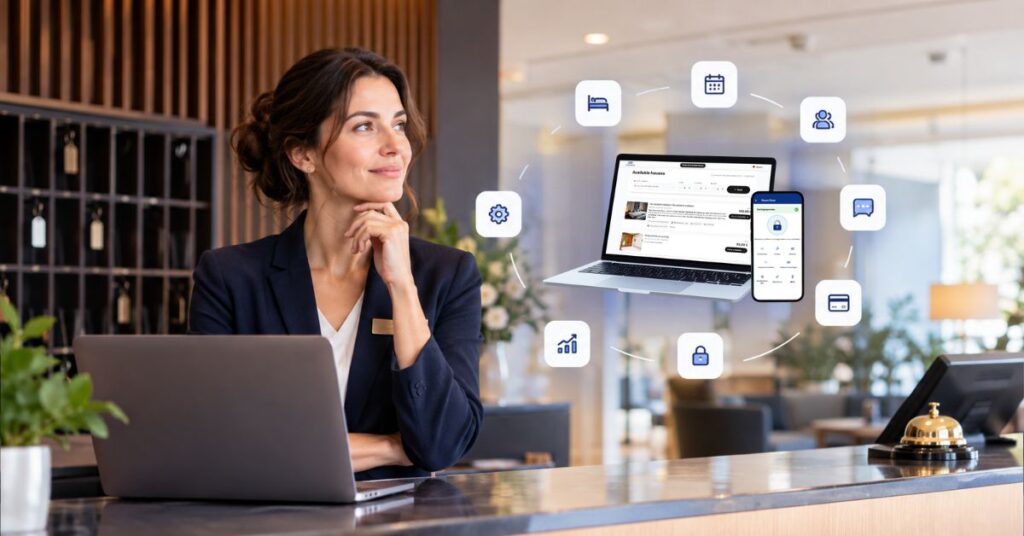
It’s Time to Switch Your Property Management System
Your hotel’s property management system (PMS) might have worked perfectly when you first started using it. When you had fewer rooms, fewer booking channels, and a smaller team, a basic system could handle most of what you needed.
But hotels grow. And when they do, their technology needs to grow with them.
As you add more rooms, take bookings from more OTAs, and give your staff more responsibilities, an outdated PMS can start slowing everyone down. Tasks that once took a few clicks may suddenly involve spreadsheets, manual updates, or switching between different systems.
And you start seeing the effects: more mistakes, longer waits at the front desk, less visibility into what’s happening at the property, and a guest experience that isn’t quite where you want it to be.
Sound familiar?
It might be a sign that your hotel has outgrown its current PMS.
7 Signs Your Hotel Has Outgrown Its PMS
1. Your Staff Is Still Doing Too Much Manual Data Entry
Let’s start with one of the easiest signs to spot: your staff is spending too much time entering the same information over and over.
If reservation details, guest information, payment data, or room status have to be updated manually across different systems, your team is doing work that a modern PMS should be handling for them.
It also leaves plenty of room for mistakes, including:
- Duplicate guest records
- Incorrect reservation details
- Data-entry errors
- Delayed updates
- Incorrect room availability
- Payment and billing mistakes
- Extra work during busy periods
This is where hotel PMS automation can make a real difference.
For example, when a guest books through an OTA or your direct booking engine, their reservation and relevant guest details should flow into your PMS automatically. If housekeeping changes a room’s status, the front desk should see that update without needing a phone call, spreadsheet, or message.
The goal is pretty simple: your PMS should take work off your team’s plate, not add to it.
If your staff is spending hours copying information from one system to another, it’s worth asking whether your current PMS is still the right fit.
2. Your PMS Doesn’t Play Well With Other Systems
A hotel rarely runs on just one piece of software.
You might have a booking engine, OTAs, payment gateways, accounting software, a CRM, housekeeping software, revenue management tools, guest communication platforms, and more.
All of these systems need to work together. That’s why PMS integrations matter so much.
Why do PMS integrations matter?
When your systems are connected properly, information can move between them automatically. Your team doesn’t have to keep jumping from one application to another or manually copy information across platforms.
For example, a well-integrated PMS can help make sure that:
- Reservations are updated automatically
- Room availability stays in sync
- Guest information is available to the right teams
- Payment information moves between connected systems
- Housekeeping gets the latest room-status updates
- Booking changes are reflected across connected channels
Without good integrations, even a simple task can turn into a multi-system process.
And that becomes more frustrating as your hotel grows.
When you’re looking at a new hotel property management system, don’t just look at the features listed on the product page. Take a close look at the integrations too. Make sure the PMS can connect with the systems you already use and the ones you may need in the future.
3. Managing Multiple Booking Channels Is Becoming a Headache
Selling rooms across multiple channels is great for reaching more guests. Managing all those channels manually? Not so much.
Your hotel might be taking reservations through:
- Your hotel website
- Booking.com
- Expedia
- Agoda
- Other OTAs
- Travel agents
- Corporate partners
- Walk-ins
- Phone bookings
As the number of channels increases, keeping rates, availability, and reservations up to date becomes much harder without proper hotel channel management.
What happens when channel management isn’t working properly?
You could end up dealing with:
- Overbookings
- Incorrect room availability
- Rate differences between channels
- Duplicate reservations
- Delayed inventory updates
- Missed booking opportunities
- More manual work for your reservations team
A PMS connected to a hotel channel manager can take much of this work out of your team’s hands.
Instead of logging into each OTA separately, your team can manage availability and rates from one place, with connected channels receiving the necessary updates.
That becomes especially valuable as your hotel expands.
More booking channels can mean more revenue opportunities, but only if your systems can keep up.
This usually becomes obvious when the reservations team starts maintaining separate spreadsheets just to double-check what the PMS and OTAs are showing.

4. Guests Are Spending Too Much Time at the Front Desk
Nobody likes waiting in line at a hotel reception desk—especially after a long journey.
If your guests regularly have to wait just to check in, take a closer look at what your PMS is making your staff do.
A traditional check-in can involve quite a few steps:
- Finding the reservation
- Verifying guest details
- Entering or updating information
- Processing payment
- Preparing registration documents
- Assigning a room
- Providing key or access information
When several guests arrive at once, those steps can quickly turn into a queue.
A modern PMS can help by supporting self check-in and other digital workflows.
For instance, guests may be able to complete some of the registration process before they even arrive. This reduces repetitive work for your front desk team and lets them spend more time helping guests who actually need assistance.
It’s also an important part of creating a smoother digital guest journey.
If your reception team spends a good part of every busy arrival period trying to work through check-in queues, see what your PMS can do to streamline the process.
Mobile check-in, self-service options, and digital registration can all help make arrival easier for both guests and staff.
5. Your PMS Is Starting to Show Up in the Guest Experience
Guests may never see your PMS, but they can definitely feel the effects of a poor one.
When information is scattered across systems or updates take too long to reach the right people, the guest experience can suffer.
Here are a few things to watch for.
Guests keep having to repeat themselves
A guest shouldn’t have to give the same information to multiple departments simply because they don’t have access to the same guest profile.
Special requests get missed
Early check-in, dietary requirements, extra amenities, room preferences—small details can make a big difference. But they’re easy to miss when information is recorded in different places.
Departments aren’t communicating effectively
Front office, housekeeping, reservations, and other teams all need accurate, up-to-date information. If they’re relying on phone calls, paper notes, or separate spreadsheets to stay informed, something is likely to fall through the cracks.
Room-status updates are slow
Imagine a room is cleaned and ready, but the front desk doesn’t know about it yet. The room is available, but the guest is still waiting.
That’s the kind of small operational issue that can have a surprisingly big impact on the PMS guest experience.
A good PMS should help connect the entire digital guest journey—from booking and pre-arrival communication to check-in, the stay, and checkout.
The best system isn’t simply the one that manages rooms. It’s the one that helps your teams work together and deliver a better experience.
6. Your PMS Keeps Going Down
Few things can throw hotel operations into chaos faster than a PMS that crashes when your team needs it most.
When the system goes down, staff may suddenly lose access to reservations, room availability, guest information, check-ins, or room-status updates.
And if there’s no quick workaround, teams may have to fall back on spreadsheets, printed reports, or even pen and paper.
That can mean:
- Longer check-in times
- More opportunities for errors
- Less visibility into reservations
- Communication problems between departments
- Difficulty managing room availability
- Extra work once the system is back online
Of course, no software is completely immune to technical issues.
But if downtime is frequent or unpredictable, that’s a different story—especially when your hotel operates 24/7.
As your property grows, reliability becomes more important, not less.
A scalable hotel PMS should support your operation without becoming a source of disruption.
When comparing PMS providers, look beyond the product itself. Consider reliability, customer support, data security, backup processes, and how the provider handles outages or service interruptions.
7. Your Reports Aren’t Giving You the Answers You Need
At a certain point, basic occupancy reports simply aren’t enough.
As your hotel grows, you need a clearer picture of what’s happening across the property. Your management team should be able to get answers without spending half a day pulling data from different systems and cleaning it up in spreadsheets.
For example:
- What’s our current occupancy?
- Which booking channels are bringing in the most revenue?
- How are our different room types performing?
- Are bookings trending up or down?
- Where are cancellations increasing?
- What does upcoming demand look like?
- How is revenue changing over time?
If your PMS can’t answer these questions easily, reporting may have become one of its biggest limitations.
Limited reporting often means more manual exports, more spreadsheets, and more time spent trying to piece together information from different places.
A modern hotel PMS reporting system should make important operational and commercial data easier to understand.
Dashboards and real-time reports can give managers a clearer view of performance without requiring hours of manual preparation.
And better visibility can lead to better decisions—from forecasting demand and managing distribution to spotting trends and responding quickly to changes.
If your management team still relies heavily on spreadsheets just to understand what’s happening at the hotel, your PMS may be holding you back.
The Bottom Line
Your PMS should grow with your hotel.
If your team is constantly entering data manually, jumping between disconnected systems, struggling with OTA management, dealing with long check-in queues, working around frequent downtime, or building reports in spreadsheets, it’s probably worth taking a closer look at your current system.
You don’t necessarily need to replace your PMS because it has one missing feature. But if several of these problems are happening at the same time, they’re telling you something: your hotel may have outgrown its current technology.
The right hotel PMS provider can help bring your operations together, automate repetitive work, connect your systems, simplify distribution, support a better digital guest journey, and give your team a clearer view of hotel performance.
And when you’re choosing your next PMS, don’t only think about what you need today.
Think about where your hotel is going.
The best system is one that can keep up with you as you grow.
